

Push Piers vs. Helical Piers: Which Is Right for Your Foundation?
Foundation settlement is common in Alexandria, Fairfax, and DC due to expansive clay soils that swell when wet and shrink when dry. Over time, this cycle can compromise the ground beneath your home.
If you’ve seen “stair-step” cracks in your brick or doors that suddenly won’t latch, you’ve probably heard about push piers and helical piers. They aren’t interchangeable. Choosing the wrong one is a waste of money; choosing the right one saves the house.
The Root of the Problem
Settlement isn’t usually a mystery. In the DMV, it’s almost always one of three things:
- Clay movement.
- Gutters dumping water right at the footer.
- Leaky pipes underground.
When the soil fails, the house sinks. It usually happens in one corner or along one specific wall first. You’ll see it in the drywall cracks, the sloping floors, or a chimney that looks like it’s trying to walk away from the house.
Push Piers: For Heavy Lifting
Push piers are exactly what they sound like.
We use the weight of your actual house to drive steel tubes deep into the earth. We keep pushing until we hit bedrock or a load-bearing layer that won’t budge.
Why we use them:
- Heavy structures: If you have a multi-story home or heavy masonry, you need the “muscle” of a push pier.
- Deep stability: They are great for reaching very deep soil layers.
- Lifting capability: Driven by hydraulic pressure, push piers are often the best choice when lifting the house back to level is required.
Helical Piers: The Precision Option
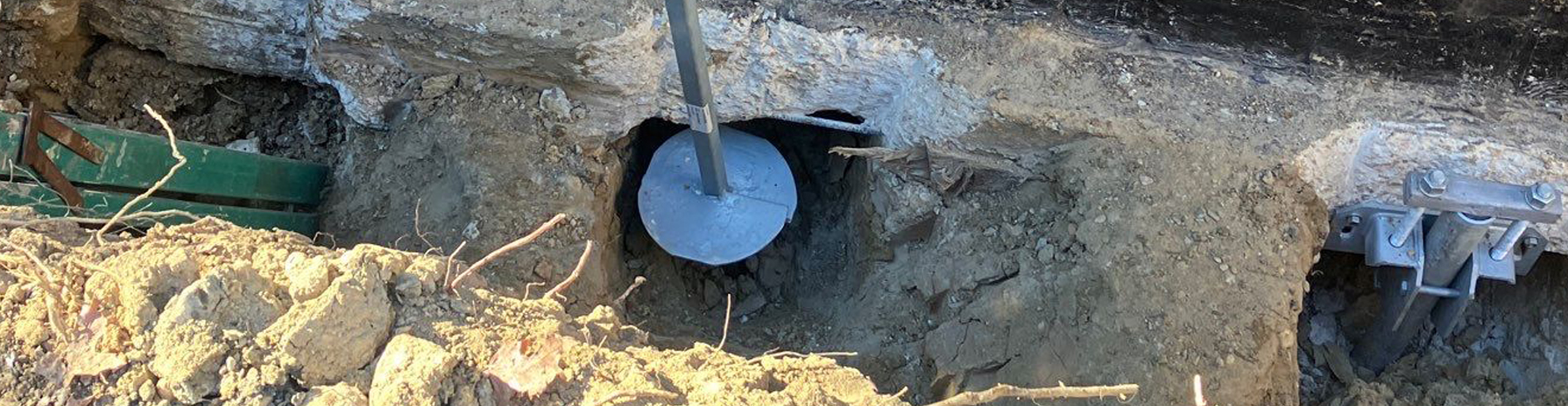
Helical piers look like giant screws. Instead of using the home’s weight, we use a hydraulic motor to “thread” them into the ground.
We monitor the torque (the resistance) as they go down, which tells us exactly when they’ve hit soil strong enough to hold the load.
Why we use them:
- Lighter structures: Ideal for porches, additions, or lighter-framed houses where insufficient weight exists for standard push piers.
- Unpredictable soil: If the soil depth varies, the torque readings give us a real-time map of the capacity.
- New Construction: We often install these before a new addition is built to prevent sinking before it starts.
Can We Actually Level Your Home?
Many homeowners ask if cracks will close. In many cases, they will.
However, stabilization is the primary goal. Lifting a house is a delicate process, and forcing it back to its original position can stress plumbing or framing.
We lift as much as the structure can safely handle, but our main objective is to ensure long-term stability.
How We Decide
We don’t pick a system based on a sales quota. We look at:
- The total weight of your home.
- The depth of stable soil in your neighborhood.
- How much the foundation has already dropped.
Don’t Forget the Water
Piers fix the result of the problem. Drainage fixes the cause.
If you install piers but still have a downspout dumping 500 gallons of water into the clay every time it rains, you’re only doing half the job. That’s why we usually look at exterior waterproofing or gutter extensions alongside the structural work.
Frequently Asked Questions
How do I know which one I need? You don’t know until we get a look at the footprint. Generally, if the house is heavy and the sink is deep, it’s push piers. If it’s a lighter structure or new work, it’s helical.
Is this a permanent fix? Yes. We are bypassing the “junk” soil and anchoring your home to the earth’s crust. It’s backed by a transferable warranty because, frankly, it’s not going anywhere.
How long does the job take? Most residential jobs are done in 2 to 5 days. It’s loud, and there’s some digging, but we’re usually in and out pretty fast.
Will it kill my grass? We have to dig to reach the footer, so some dirt will be moved. We keep the footprint as small as possible and put the landscaping back together when we’re done.
Related Resources
Stop the Sinking
Foundation problems don’t get better with age. They just get more expensive. If you’re seeing the signs in Alexandria, Fairfax, or DC, let’s get a specialist out there to give you a straight answer.
We don’t send “closers.” We send experts.
Choosing between push piers and helical piers depends on your soil conditions, foundation type, and structural needs. Our team provides expert foundation inspections to determine the best solution.
Contact DMV
We’d love to help. Let us know what you need.
"*" indicates required fields